AWS Unveils Robust Active-Active Multi-Region Architecture for CloudFormation Custom Resources, Enhancing Enterprise Resilience and Global Operations.

Amazon Web Services (AWS) has introduced a sophisticated active-active multi-Region architecture designed to address the long-standing challenge of achieving high resilience for AWS CloudFormation Custom Resources. This innovative solution provides a robust framework for organizations requiring stringent disaster recovery objectives, data residency mandates, and continuous business continuity across multiple geographical regions, effectively transforming CloudFormation into a truly extensible orchestration engine without sacrificing reliability.
Understanding the Imperative: The Evolution of Infrastructure-as-Code and Multi-Region Demands
Infrastructure-as-Code (IaC) has become a cornerstone of modern cloud operations, enabling organizations to manage and provision their computing infrastructure through machine-readable definition files, rather than physical hardware configuration or interactive configuration tools. AWS CloudFormation stands as a foundational IaC tool for thousands of enterprises leveraging the AWS ecosystem. It allows users to model, provision, and manage AWS and third-party resources, treating infrastructure as version-controlled code. This approach promotes consistency, reduces manual errors, and accelerates deployment cycles.
However, as organizations push the boundaries of what native CloudFormation can achieve, the need for custom logic arises. This is where CloudFormation Custom Resources become indispensable. A CloudFormation custom resource allows developers to write bespoke provisioning logic that AWS CloudFormation invokes during stack operations (Create, Update, or Delete). When CloudFormation encounters a custom resource in a template, it dispatches a lifecycle event to a designated target, typically an AWS Lambda function, often routed through an Amazon Simple Notification Service (SNS) topic. CloudFormation then awaits a response via a presigned URL, proceeding or rolling back based on the outcome.
The utility of custom resources is vast, extending CloudFormation’s capabilities far beyond its native resource provisioning. They are commonly used for tasks such as integrating with third-party services not directly supported by CloudFormation, executing complex data transformations, managing license keys, interacting with on-premises systems, or even provisioning custom DNS records. In essence, custom resources elevate CloudFormation from a mere resource provisioner to a fully extensible orchestration engine, capable of managing virtually any operational workflow.
While single-Region deployments can achieve commendable levels of resilience through various high-availability patterns, the demands of global enterprises often necessitate multi-Region architectures. These requirements stem from critical business drivers:
- Disaster Recovery (DR) Objectives: Minimizing Recovery Time Objective (RTO) and Recovery Point Objective (RPO) in the event of a regional outage.
- Data Residency Mandates: Adhering to regulatory or compliance requirements that dictate where data must be stored and processed geographically.
- Latency-Sensitive Use Cases: Serving users globally with minimal latency by deploying resources closer to their geographical locations.
- Mission-Critical Business Continuity: Ensuring uninterrupted operation for applications where downtime is simply not an option.
Despite the critical role of custom resources and the increasing necessity of multi-Region deployments, a significant gap has persisted: CloudFormation Custom Resources lacked native multi-Region support. This absence introduced a series of complex problems, including single points of failure if custom resource handlers were confined to a single region, the potential for duplicate processing in naive multi-Region setups, and the inherent complexity of building custom coordination mechanisms. Until now, teams were often forced to either accept the reliability risks of single-Region custom resource handlers or invest substantial resources in developing intricate, bespoke solutions to manage multi-Region scenarios, adding to operational overhead and increasing time-to-market.
The AWS Solution: An Active-Active Blueprint for Multi-Region Custom Resource Processing
To overcome these limitations, AWS has engineered a robust active-active multi-Region solution for CloudFormation custom resource processing. This architecture is founded on four core principles designed to ensure high availability, prevent data inconsistencies, and enable seamless failover:
- Active-Active Processing: Events are simultaneously sent to and processed by infrastructure in multiple AWS Regions, ensuring continuous operation even if one region experiences issues.
- No Single Points of Failure: The design eliminates any single component or region whose failure would compromise the entire custom resource processing workflow.
- Idempotency and Distributed Locking: Mechanisms are in place to ensure that custom resource operations are processed exactly once, preventing unintended side effects from duplicate invocations. This is crucial for maintaining data integrity in a distributed system.
- Automated Failover: The architecture incorporates automated mechanisms to detect failures and seamlessly transition processing responsibilities, minimizing human intervention and recovery times.
This architectural pattern is particularly suited for mission-critical workloads where regional failures are intolerable. By distributing the processing load and incorporating sophisticated coordination mechanisms, it avoids the pitfalls of both single-Region custom resource designs and simplistic multi-Region approaches that risk duplicate processing.
Architectural Deep Dive: A Step-by-Step Processing Flow
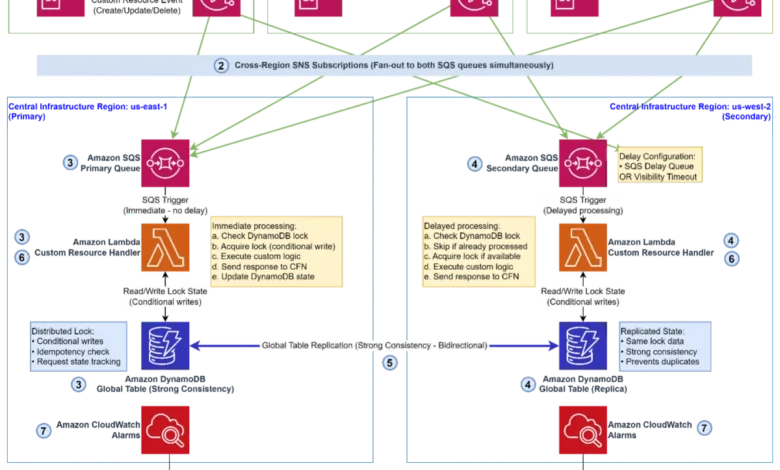
The proposed architecture leverages a primary central Region (e.g., us-east-1) and a secondary Region (e.g., us-west-2) to process custom resource events. Amazon DynamoDB Global Tables provide distributed locking and idempotency, while Amazon Application Recovery Controller (ARC) facilitates automated failover. Customer AWS Regions fan out events simultaneously to both infrastructure Regions, ensuring resilience even if the primary processing Region encounters an issue.
The detailed processing flow unfolds as follows:
Step 1: Event Initiation (Customer Regions)
A CloudFormation Stack, residing in any of the customer’s operational Regions (e.g., us-east-1, eu-west-1, or ap-southeast-1), initiates a Create, Update, or Delete lifecycle event for a custom resource. Crucially, along with the event payload, CloudFormation generates a unique, presigned response URL. This URL is the designated callback endpoint that the custom resource handler must invoke to signal the success or failure of the operation back to CloudFormation. The event is then published to a local Amazon Simple Notification Service (SNS) topic within that specific customer Region.
Step 2: Cross-Region Fan-out with SNS Subscriptions
The Amazon SNS topic in the customer Region is meticulously configured with cross-region subscriptions. This configuration enables the event to be simultaneously fanned out to two Amazon SQS queues, strategically located in the designated central infrastructure AWS Regions: one queue in the primary infrastructure Region (e.g., us-east-1) and another in the secondary infrastructure Region (e.g., us-west-2). Both SQS queues receive the event nearly concurrently, establishing the foundation for the active-active processing model. This parallel delivery is a critical component for achieving high availability and reducing potential latency.
Step 3: Primary Lambda Function Handler (Immediate Processing)
The SQS queue in the primary infrastructure Region triggers its corresponding Primary Lambda Custom Resource Handler without any intentional delay. This Lambda function immediately commences processing the event. Its execution involves several key actions:
- Acquiring a Distributed Lock: The Lambda function attempts to acquire a distributed lock in Amazon DynamoDB Global Tables for the specific custom resource event. This lock is crucial for ensuring that only one instance of the handler (either primary or secondary) successfully processes the event.
- Processing the Custom Logic: If the lock is successfully acquired, the Lambda function proceeds to execute the custom provisioning or de-provisioning logic defined for the custom resource. This might involve interacting with other AWS services, external APIs, or complex data manipulations.
- Updating State in DynamoDB: Upon successful completion of the custom logic, the handler updates the event’s status in the DynamoDB Global Table to ‘COMPLETED’.
- Sending CloudFormation Response: Finally, the Lambda function sends a SUCCESS callback to the presigned URL provided by CloudFormation. This signals to CloudFormation that the custom resource operation was successful, allowing the stack operation to continue. If the custom logic fails, a FAILED callback is sent, triggering a CloudFormation rollback.
Step 4: Secondary Lambda Function Handler (Delayed Processing)
In parallel, the SQS queue in the secondary infrastructure Region is configured with a deliberate delay. This delay can be implemented either through an SQS Delay Queue or by setting an extended Visibility Timeout on the queue itself. After this predefined delay period elapses, the Secondary Lambda Custom Resource Handler is triggered. Its processing logic mirrors that of the primary handler:
- Attempting to Acquire Lock: The secondary Lambda function also attempts to acquire a distributed lock in the DynamoDB Global Table for the same custom resource event.
- Conditional Processing: If the primary handler has already successfully acquired the lock and completed processing, the secondary handler will find that the lock is already held or that the event status is ‘COMPLETED’. In this scenario, the secondary handler gracefully exits without performing any further actions, thus preventing duplicate processing.
- Failover Execution: However, if the primary Region experiences a failure or is unable to complete processing within the delay window (e.g., due to a regional outage, Lambda execution error, or network partition), the secondary handler will be able to acquire the lock. It then proceeds to execute the custom logic, update the status in DynamoDB, and send the CloudFormation response, effectively taking over the processing responsibilities.
The strategic delay for the secondary handler is critical. It provides the primary Region sufficient time to process the event under normal operating conditions. The secondary only intervenes and takes ownership if the primary fails to complete processing within this window, acting as an automatic failover mechanism at the application logic level.
Step 5: DynamoDB Global Tables: Distributed Locking and Idempotency
Amazon DynamoDB Global Tables are the linchpin of coordination and state management in this architecture. They provide a fully managed, multi-Region, multi-master database that enables applications to perform low-latency reads and writes to data in any AWS Region. Both the primary and secondary infrastructure Regions interact with the Global Table, ensuring strong consistency across all replicas. The table is used to track critical information:
- Event Status: Whether an event is ‘PENDING’, ‘PROCESSING’, or ‘COMPLETED’.
- Distributed Lock: A mechanism to ensure that only one custom resource handler instance can process a specific event at any given time. This prevents race conditions and duplicate operations.
- Idempotency Key: A unique identifier for each custom resource event, ensuring that even if an event is re-delivered or re-processed, the underlying operation is executed only once logically.
Bidirectional replication inherent in DynamoDB Global Tables is designed to maintain all Regions with the absolute latest state. This capability is paramount for the reliability of the lock mechanism, ensuring that both primary and secondary handlers have an accurate view of the event’s status and lock ownership, even in the face of potential network partitions or regional degradation.
Step 6: CloudFormation Response
Irrespective of whether the primary or secondary Lambda function handler completes the processing, a crucial final step is the callback to CloudFormation. The handler invokes the presigned URL provided at the event’s initiation, sending either a SUCCESS or FAILED status. Based on this unambiguous response, CloudFormation intelligently decides whether to continue the stack operation (if successful) or to initiate a rollback (if failed), maintaining the integrity of the infrastructure state.
Step 7: Amazon CloudWatch Monitoring
To provide continuous oversight and early warning, Amazon CloudWatch alarms are deployed to continuously monitor key metrics. These include SQS queue depth in both the primary and secondary Regions (indicating potential backlogs or processing issues) and Lambda execution health (monitoring errors, invocations, and duration). These alarms serve as the vital early warning system that feeds into the automated failover mechanism.
Step 8: Automated Failover with Amazon Application Recovery Controller (ARC)
The pinnacle of resilience in this architecture is the integration with Amazon Application Recovery Controller (ARC). If the primary infrastructure Region (e.g., us-east-1) experiences a significant failure, the CloudWatch alarms detect this deviation from normal operational parameters. These alarms then trigger ARC to initiate an automated failover to the secondary infrastructure Region (e.g., us-west-2). ARC’s role is to manage and coordinate the failover process, ensuring that the secondary Region seamlessly assumes full processing responsibilities without requiring manual intervention. This dramatically reduces the Recovery Time Objective (RTO) and minimizes disruption to business operations.
Industry Implications and Expert Perspectives
This architecture represents a significant advancement for organizations leveraging AWS at scale. It provides a blueprint for extending the power of CloudFormation to address the most demanding resilience requirements, eliminating a previous barrier to truly global and highly available cloud deployments.
"The demand for multi-Region architectures is no longer a niche requirement; it’s a fundamental expectation for mission-critical applications and businesses operating globally," notes an AWS cloud architecture specialist. "Our customers have consistently sought robust patterns to extend the capabilities of CloudFormation Custom Resources into these highly resilient environments. This active-active solution, underpinned by DynamoDB Global Tables for strong consistency and ARC for automated failover, provides a standardized and highly reliable pathway forward. It allows enterprises to meet stringent compliance requirements, like data residency, while simultaneously enhancing their disaster recovery posture and ensuring continuous operations across geographies."
The implications are far-reaching:
- Enhanced Reliability and Business Continuity: Organizations can now deploy custom resource logic with the confidence that it will remain operational even during regional outages, significantly improving application uptime.
- Simplified Compliance: For industries with strict data residency requirements, this architecture facilitates the deployment of compliant custom resource handlers, ensuring data processing occurs within specified geographical boundaries.
- Reduced Operational Overhead: By providing a standardized, well-architected pattern, AWS reduces the need for individual teams to build complex, bespoke multi-Region solutions from scratch, freeing up engineering resources to focus on core business innovation.
- Faster Innovation: Developers can leverage custom resources more extensively for critical workflows, knowing that the underlying resilience is robustly handled by a proven AWS pattern.
- Improved Disaster Recovery Posture: The active-active nature and automated failover capabilities drastically reduce RTO, making it easier for organizations to meet aggressive DR targets.
This architecture specifically addresses the challenges of single points of failure, the complexity of cross-region coordination, and the need for idempotency, which were previously significant hurdles. By standardizing these aspects, AWS is empowering its customers to build more sophisticated and resilient cloud-native applications.
Looking Ahead: Continuous Enhancement of Cloud Operations
The introduction of this active-active multi-Region architecture for CloudFormation Custom Resources underscores AWS’s continuous commitment to providing tools and patterns that enable customers to build highly resilient, globally distributed applications. As cloud adoption accelerates and the complexity of enterprise workloads grows, such architectural guidance and integrated service offerings become increasingly vital. For teams operating at scale across multiple AWS Regions, this architecture provides an invaluable foundation for extending the power of CloudFormation without compromising on reliability, offering a clear path towards truly global high availability and operational excellence. Organizations are encouraged to explore the provided resources and documentation to implement this pattern and fortify their cloud infrastructure against regional disruptions.